
Dissect.ai | From Days to Minutes: How AI is Transforming Data Analysis for Businesses
- Moksha Sharma
- Oct 1, 2025
- 6 min read

Introduction: The Last Mile Problem in Data Science
Imagine walking into a library with millions of books, yet no librarian to guide you. Every tome represents a metric, every shelf a dashboard, and scattered notes from past visitors are the raw reports piled on tables. The answers exist somewhere in this maze, but finding them can take days, or weeks. This is the reality many organizations face today: abundant data, yet slow and costly insights.
Dissect.ai steps in as a precise guide rather than a replacement for human judgment. It doesn’t write the narrative for you; it points you to the passages that matter, allowing analysts to focus on interpretation, strategy, and higher-order decision-making. By automating routine analysis, the platform transforms the “last mile” of data work into a streamlined, reliable process.
Problem Statement: The Cost of Redundant Human Analytics
Even with modern tools, many organizations face two persistent challenges:
Oversized Analytics Teams: Entry-level analysts often spend their days producing routine reports, checking for anomalies, or performing basic regressions - tasks that could be automated.
Fragmented Tools: Multiple platforms for visualization, exploration, and reporting create duplication, cognitive overload, and slow insight generation.
The consequences are clear:
Multi-day report turnaround slows decision-making.
High labor costs inflate analytics budgets.
Insights are inconsistent, difficult to reproduce, and sometimes misaligned with strategy.
Consulting studies reinforce this picture. McKinsey notes that organizations adopting AI can achieve double-digit reductions in analytics costs, while BCG emphasizes AI as a lever for operational efficiency. Yet adoption is uneven, leaving a gap between potential and realized value.

The Solution: Dissect.ai as a Librarian for Your Data
If data is a sprawling library, analysts are the readers, and dashboards are the shelves, then the challenge is obvious: finding the right insight among millions of “books” takes enormous time and effort. Dissect.ai will act as the librarian who knows exactly where to look. It doesn’t write the story for you -it ensures you reach the passages that matter, quickly and reliably.
Key capabilities include:
Auto-EDA (Exploratory Data Analysis): Automatically catalogs datasets, flags anomalies, and highlights data quality issues, much like a librarian tagging the most relevant manuscripts.
Auto-Hypothesis Testing: Suggests and validates relationships between metrics, guiding analysts toward meaningful correlations instead of leaving them to wander through endless shelves.
Auto-Visualization: Generates charts and narrative summaries tailored to your business questions, akin to a librarian presenting curated excerpts for quick comprehension.
ML-Driven Insights: Lightweight predictive models surface trends like churn risk or demand fluctuations, turning scattered information into actionable knowledge.
Workflow Integration: Delivers insights straight to Slack or email, placing the “books” directly in the hands of decision-makers.
By organizing the data “library,” Dissect.ai allows analysts to focus on strategy and interpretation, rather than repetitive tasks.

Positioning: A Focused Approach to Analytics
Unlike generic analytics or visualization tools, Dissect.ai focuses exclusively on automating the routine, time-consuming tasks of business analysts rather than serving data scientists or engineers. Where traditional platforms require manual setup, fragmented dashboards, or specialized expertise, Dissect.ai will act like a skilled librarian - guiding users to the insights that matter, streamlining workflow, and reducing cognitive overload.
This accessibility means organizations no longer need specialized expertise to unlock insights - Dissect.ai empowers both technical and non-technical teams to deploy, use, and benefit from analytics without friction.
Use Cases Across Industries
Dissect.ai will prove effective across sectors where data is plentiful and speed of insight matters:
Startups: Lean teams gain real-time analytics without hiring a full bench of analysts.
E-commerce: Automated cohort analysis, funnel optimization, and campaign impact reporting.
SaaS: Usage trend tracking, feature adoption reports, and churn modeling.
FMCG & Retail: Demand forecasting, inventory management, and distribution optimization.
Manufacturing:
Predictive Maintenance: Anticipates equipment failures to reduce unplanned downtime.
Production Line Optimization: Identifies bottlenecks and maximizes throughput.
Quality Control: Detects anomalies and ensures consistent product standards.
Resource Allocation: Guides inventory, labor, and materials decisions to minimize waste and cost
Across industries, organizations report 60–70% reductions in routine analytics workload, allowing teams to focus on strategy, innovation, and high-value decision-making.
Metric | Before Dissect.ai | After Dissect.ai |
Analyst Headcount | 5 | 2 |
Report Turnaround | 3 days | 15 minutes |
Decision Velocity | Slow | High |
Annual Analytics Spend | $250,000 | $90,000 |

ROI Snapshot: From Cost Center to Strategic Lever
Early adopters have realized measurable impact. Consider a mid-sized analytics team:At a larger scale, savings are substantial. A 50-analyst organization, with a fully-loaded cost of $120k per analyst (~$6M annually), could reduce routine workload fivefold using Dissect.ai.
With ~10 analysts handling exceptions and AI platform costs ($1.2M/year), steady-state expenses fall to ~$2.4M - saving 60% annually while improving speed and accuracy.
This combination of efficiency, cost reduction, and faster decision-making highlights the fiduciary value of the platform.
Market Perception
The current talent landscape in data analytics highlights a striking industry-wide observation: while technical skills remain strong - SQL proficiency, dashboard creation, and reporting capabilities - these alone no longer distinguish top performers.
Organizations, including those actively hiring, are noticing a critical gap. Despite interviewing dozens of candidates, it’s clear that many analysts lack a deep business understanding. They can execute instructions flawlessly, but that is exactly what AI can now replicate efficiently.
In this evolving context, the true differentiator is not technical execution, it is the ability to think critically, interpret data strategically, and connect insights to business outcomes. Companies are increasingly recognizing that fostering these skills in their teams, or supplementing them with tools like Dissect.ai, delivers a decisive competitive edge.
A Day in the Life: Analytics Reimagined
A product analyst’s typical day often begins with hours of data wrangling - pulling from multiple sources, cleaning inconsistencies, and reconciling formats. By late morning, they run exploratory analyses and create charts, often repeating tasks that yield slow insights. Afternoon is consumed by compiling reports and dashboards, responding to ad-hoc manager queries, and trying to keep decision-making moving despite bottlenecks. By day’s end, much effort has gone into routine tasks, leaving little time for strategic thinking.
Dissect.ai transforms this workflow:
Automated Data Prep: Cleans, aligns, and corrects datasets instantly.
Instant Exploratory Analysis: Generates statistical summaries, visualizations, and hypotheses in minutes.
Rapid Report & Dashboard Creation: Delivers ready-to-use insights directly to existing workflows.
Real-Time Ad-Hoc Queries: Allows managers to get answers via plain-language prompts.
Impact: Analysts can now focus on interpreting results, guiding decisions, and driving innovation—while the system handles routine, time-consuming tasks.
Task | Before Dissect.ai | After Dissect.ai |
Data Cleaning & Prep | 2–3 hours daily | Automated, instant |
Exploratory Analysis | 1–2 hours per dataset | Generated in minutes |
Report & Dashboard Creation | 2–3 hours | Ready-to-use, delivered directly |
Ad-Hoc Queries | Hours of manual analysis | Real-time answers via prompts |
Analyst Focus | Routine, repetitive work | Strategic interpretation & decision-making |
Adoption Considerations
To maximize the value of Dissect.ai, organizations benefit from attending to a few practical considerations:
Data Security: Ensuring that data handling aligns with organizational policies is essential. Dissect.ai supports robust security measures across cloud-based and on-premise deployments to maintain governance and confidentiality.
Change Management: Transitioning from manual workflows to automated insights is most effective when teams are aligned and supported. Proper onboarding and clear processes help unlock the full potential of the platform.
By focusing on these areas, organizations can confidently adopt Dissect.ai, ensuring smooth implementation, reliable results, and strategic impact.
With these efficiency gains and measurable cost savings clearly illustrated, it becomes equally important to address practical considerations that ensure the platform delivers consistent value across organizations.
Roadmap: From MVP to Product-Market Fit
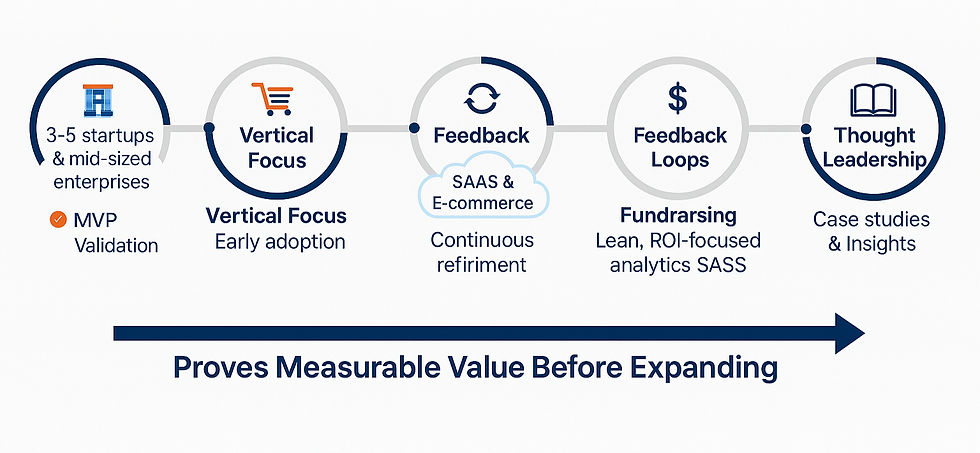
Dissect.ai’s near-term strategy emphasizes precision before scale:
Pilot Programs: 3–5 start-ups and mid-sized enterprises for MVP validation.
Vertical Focus: SaaS and e-commerce as early adopters, leveraging modern data stacks.
Feedback Loops: Continuous refinement based on actual usage patterns.
Fundraising: Presenting Dissect.ai as a lean, ROI-focused analytics SaaS.
Thought Leadership: Publishing case studies and insights to drive credibility and adoption.
This deliberate approach proves measurable value before expanding.
Wider Implications
Platforms like Dissect.ai signal a broader shift in organizational thinking. As Herbert Simon observed, “A wealth of information creates a poverty of attention.” By automating routine analysis, companies restore focus to high-value decision-making rather than repetitive tasks.
Real-world examples confirm this trajectory:
Databricks’ GenAI assistant reduced financial analyst routine workload by ~70%.
Goldman Sachs uses internal AI tools for document summarization, analysis, and drafting - boosting productivity while maintaining governance oversight.
Consulting studies show measurable cost savings and faster operational execution across sectors.
The lesson is clear: AI is no longer peripheral; it is central to modern decision-making.
Conclusion: The Future Analyst Is an Algorithm
Dashboards once promised clarity; instead, they often amplified complexity. Dissect.ai demonstrates that automation can replace friction, not judgment, turning routine work into actionable insights delivered in minutes.
The platform does not replace intuition, it enhances it. In today’s fast-moving markets, organizations that combine intelligent systems with human judgment gain speed, accuracy, and strategic leverage. The question is no longer if automation will arrive - but how swiftly leaders will align with it.

Comments